 EN
EN
 ES
ES

The Counterfeits of Mexico's 1856, 1861, and 1867 Issue
This article was originally published in MEPSI's journal, Mexicana, in January 2001. It provides detailed descriptions of the known counterfeit types based on Mexico's first stamp design. The image quality was limited by the black and white format, however. For high-resolution, full color images of many of the counterfeit types described below, please refer to the October 2023 article by Marc Gonzales, "Counterfeits of the 1856-1861 Issue: A New Discovery."
Introduction
This paper lists, illustrates, and describes all of the known counterfeits of Mexico's 1856, 1861, and 1867 issues. Here the term "counterfeit" means that the basic stamp, the overprint (if any), and the y.' cancel (if any), are imitations of reality. Sixteen different counterfeit types will be presented. All of these counterfeits were made for stamp collectors. None were made to frank mail and thus to defraud the government. Except for two dangerous types. most of these counterfeits are crude and present little or no problem to the modern collector. All will be illustrated and described so that the dangerous types can be detected and the other types can be properly classified.
Counterfeit stamps of most countries that were made to sell to collectors have existed since the very early days of philately. The first publication describing counterfeits was written and published by J. B. Moens in 1862 [1]. Moens listed 192 counterfeits from 45 different countries. Moens listed no counterfeits of Mexico. Apparently there were no Mexico counterfeits in 1862. It did not take long for this situation to be remedied, and the first description of Mexico counterfeits appeared in the literature in 1865 in a book by Thomas Dalston [2]. Dalston describes these counterfeits as:
Mexico
1857. [sic] – 2 reales green on white paper.
Same issue—½ real blue, 1 rl. yellow, 2rs. green, 4 rs. red, 8 rs. violet. 1861 issue—black impression on coloured paper, ½ rl., 1 rl., 2 rs., 4 rs. red on yellow, 8 rs. green on brown, and several more of the same design, but fictitious colours. In all 20 varieties.
The colouring of the above imitation is extremely poor and thin, and the lettering very indistinct and irregular. The top inscription is Medico instead of Mexico. They are, in fact, so poorly executed that it is utterly impossible for them to victimize collectors.
Clearly, Dalston's knowledge of Mexico's 1856 and 1861 issues was imperfect; however, he provided sufficient information about the counterfeits to permit their detection. These counterfeits will be discussed in this paper as Counterfeit Type I.
The makers of the earliest counterfeits offered them as genuine because most collectors had no way to tell the genuine from the fakes. As the literature of philately grew and as collectors became more sophisticated, some, but not all, counterfeit makers offered their wares as facsimiles useful as space fillers. There was a significant market for space fillers during the 19th century and up until 1914. The last major marketer of space fillers, François Fournier [3], was forced out of business by the difficulties of mailing stamps across international borders after the start of World War I. (The demand for space fillers has never completely gone away, and one can find counterfeit stamps advertised as space fillers on eBay today). Although many counterfeits were initially offered as facsimiles, some counterfeits, especially the better ones, continued to be manufactured and offered as genuine stamps.
The birth of some counterfeits was not at all sinister. Pictures of stamps were sometimes used to liven up advertising material. For example towards the latter part of 19th century colorful pictures started to be used to illustrate advertising cards. These advertising cards are generally called Victorian Trade Cards. Typically, one side of these cards contained a colored picture and the other side contained an advertisement. Colored pictures of stamps were used on some Victorian Trade Cards. There are instances where the pictures were cut off of the trade cards and offered as stamps. One of the Mexico counterfeits discussed in this paper, Counterfeit Type XI, arose in this manner. Another more modern source is stamps on stamps. The illustrated stamp can be cut from the master stamp and offered as genuine — Counterfeit Type XII is an example.
Some of the counterfeits of Mexico's first issues have been described by Earée in Album Weeds, or How to Detect Forged Stamps [4] and by Serrane in Vade-Mecum du Spécialiste-Expert en Timbres-Poste hors d'Europe. Earée lists seven counterfeit types of the 1856 issue and indicates that three of these types were also used to imitate the 1861 stamps. Serrane lists eight types. Serrane does not list one of the types listed by Earée and two of the types listed by Seranne are not listed by Earée, so together they list nine types of counterfeits. These two books are still useful today, but they have limitations. There are counterfeits that are not listed in either. The counterfeits are not illustrated in either book, although Serrane does present some line drawings that are useful. The descriptions of the counterfeits are sometimes difficult to follow. Serrane can be very vague at times and is not always accurate. This paper can be regarded as an update of the Mexico 1856 and 1861 section of Earée's and Serrane's classic books. All of the counterfeits listed by Earée and by Serrane plus seven additional ones are illustrated and described.
Who made the counterfeits? That is an intriguing question, but unfortunately the answer is not known for most of them. Counterfeits were discussed in the philatelic literature of the 19th century, but few, if any, were
illustrated. During much of the 20th century, when it became possible to illustrate stamps in publications, most collectors adopted a Victorian attitude toward counterfeits, and they were not discussed openly. This situation has
changed in recent years. The collection, study, and documentation of counterfeit stamps are now accepted parts of philately. From time to time one finds attributions in old reference collections. Since the author had no way to
verify most of these attributions it was decided to not include them in this paper except in those few cases where they could be verified with a reasonable degree of certainty.
In the description of the counterfeits in this paper, if the counterfeit was listed by Earée in his 1903 book, or by Serrane, this will be so stated. All of the counterfeits listed by Earée in his 1903 third edition were also listed in his 1892 second edition [5]. Dalston published the first description of Mexico counterfeits in 1865 [2]. Therefore, the years 1865-1892 provide a gross bracket for the time of first preparation of all the counterfeits identified in this paper as known to Earée (Counterfeit Types I through VII).
A Review of the Basic 1856, 1861, and 1867 Stamps
Mexico's 1856 issue consists of stamps in five denominations. The denominations exhibit a common design featuring a bust of Miguel Hidalgo y Costilla. The stamps are printed with engraved plates on white wove paper of medium thickness (0.07 to 0.09 mm). They differ from each other in the value table at the bottom of the stamp and in the color (ignoring minor plate and printing varieties). Specifically the 1856 issue consisted of the ½-real in blue and shades of blue, the 1-real in yellow and shades of yellow, the 2-reales in green and shades of green, the 4-reales in red and shades of red, and the 8-reales in violet and shades of violet. A genuine ½-real stamp of the 1856 issue is illustrated below in Figure 1.
In 1861 a new issue of stamps was introduced. The 1861 issue consisted of stamps of the same design as the 1856 issue, but printed in black on paper of various colors. In addition the 1861 issue contained a 4-reales and an 8-reales stamp printed in color on colored paper. The 1861 papers are wove and are of medium thickness. Specifically the 1861 issue consisted of the ½-real black on buff, the 1-real black on green, the 2-reales black on pink (many of these 2-reales stamps exhibit very little pink in a paper that appears to be white or off-white), the 4-reales black on yellow, the 4-reales dull rose on yellow, the 8-reales black on red brown, and the 8-reales green on red brown. The 1861 issue consisted of seven stamps in five denominations.
In 1867 some denominations were printed in colors and on paper similar to, but somewhat different from, the 1861 printings. Since the colors of most counterfeits do not match the correct colors very well and since most of the counterfeits do not have district overprints, it is not possible to tell if a specific counterfeit was intended to imitate the 1861 stamps or the similar 1867 stamps. In this paper counterfeits that resemble the 1861 colors are assumed to be 1861 counterfeits.
There was a distinct group of stamps with the 1856-1861 design printed in 1867. These stamps were printed on a thin gray blue paper. This set consisted of the ½-real gray, the 1-real blue, the 2-reales green, and the 4-reales rose, all printed on thin gray blue paper. A few counterfeits exist on gray paper in colors that are similar to the color to the genuine stamps printed on the gray blue paper. These latter counterfeits will be listed in this paper.
Almost all of Mexico's 1856. 1861, and 1867 stamps have district overprints. There are some "without overprint" varieties to be sure, but most of the genuine stamps do have overprints.
Some General Remarks about the Counterfeits
Most of the counterfeits were printed by lithography. The genuine stamps were printed from engraved plates. The impressions of most genuine stamps stand out from the paper while the impressions of the counterfeits are flat. Therefore, aside from differences in design, the counterfeits have a different general appearance than the genuine stamps. This generalization holds true for most genuine stamps: however the engraved plates became worn before the end of their lives. Some genuine stamps printed from these worn engraved plates have the appearance, more or less, of stamps printed by lithography. Flat appearance is a good screening tool for counterfeits, but other tests need to he made before a final decision about authenticity is made.
The counterfeiters had difficulty in matching the color of the genuine stamps. In this paper, if the color of a counterfeit resembles even slightly the color of a corresponding genuine stamp, it will be listed as a counterfeit of the genuine stamp. This does not mean that the colors of the two are necessarily close at all. Indeed, differences in color and shade, while impossible to demonstrate in this paper, can be an important factor in separating the genuine from the bad.
Very few of the counterfeits have district overprints. If overprints are known on the counterfeits, the overprints will he described. Many of the counterfeits have fake cancels and these cancels will also be described. Of course, fake overprint and fake cancels can be added at any, time. For this reason this description of overprints and cancels is not necessarily the last word on these features.
Most of the counterfeits do not have gum. Obviously, if the counterfeits were supplied with forged cancels then gum would not be necessary. It seems that most counterfeiters did not bother to apply gum to the uncancelled stamps either. If counterfeits are known with gum, then this will be stated in the description of the counterfeit. Again, gum could still be applied at any time. So the presence of gum is not a good test for counterfeits.
A significant percentage of the counterfeits are damaged. This is evidence that many of the counterfeits were used to fill space in the old glued-down collections. The counterfeit collector needs to keep this in mind when setting "condition" standards for his counterfeit collection.
Clichés and dies used to illustrate stamp albums and other stamp publications can also be used to print counterfeit stamps. However, the author was unable to assign any of the stamps listed in this paper to this source. Items that appear to be stamps printed in black on more or less white paper do turn up from time to time. The author has assumed that these have been cut from philatelic publications, and these are not included in this paper.
The colors assigned to the counterfeits in this paper are based on a comparison of the stamps to the colors in the Methuen Handbook of Colour [7].
The author has been collecting counterfeits of Mexican stamps for more than 20 years. During that time he has accumulated a sizable collection of this material. The listings in this paper are based on the study of this material. The listings have been crossed checked with other reference collections. Even so, there can be little doubt that there are counterfeits that are unknown to the author, and he would appreciate hearing about any additional counterfeits of Mexico's 1856, 1861, and 1867 stamps.
Counterfeit Type I
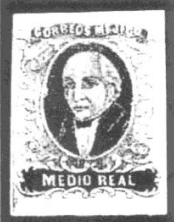
This crude counterfeit is the one described by Dalston in his 1865 book [2]. It is Earée's Third Forgery and Serrane's Counterfeit A. The counterfeit set includes all five of the 1856 denominations and all seven of the 1861 denominations. An 8-reales Type I counterfeit is illustrated below in Figure 2.
The Type I counterfeits are lithographed on hard wove paper. The thickness of the paper varies from medium (about 0.08 mm) to thick (about 0.13 mm depending primarily on the color of the paper. There is some variation of thickness within each paper color.
The colors of the counterfeits of the 1856 stamps are: ½-real light to dark blue, 1-real light yellow, 2-reales light to dark grayish green, 4-reales grayish red, and 8-reales light to dark gray (not violet). All of the 1856 counterfeits are on white or off-white paper. The colors of the Type I counterfeits of the 1861 stamps are: ½-real black on brownish orange paper, 1-real black on shades of greenish blue paper, 2-reales black on grayish red paper, very light pink paper, and on off-white paper, 4-reales black on grayish yellow paper, 4-reales grayish red on light yellow paper, 8-reales black on brownish orange paper, and 8-reales shades of dark green on brownish orange paper.
There is an error in the set: "REALES" on about half of the l-real counterfeits is spelled "FEALES." This error occurs on both the 1856 and 1861 counterfeits. In the collection of the author is a block of 4 of the 1-real 1856 counterfeit with the top two stamps having "REALES" and the bottom two stamps having "FEALES." From this it can be concluded that both spellings were in the 1-real stone. It is the opinion of the author that this is a real error and not an error made for collectors.
Dalston states that there are 20 varieties of this counterfeit [2]. These probably include the counterfeits of the twelve genuine stamps in the 2 sets, plus the two "FEALES" errors., plus six of the color varieties mentioned above.
None of the counterfeits have district overprints. About one fourth have no cancel and the remaining have one of several crude cancels. Some of the cancels are: a grid of black lines, a grid of small black rectangles, black non-descriptive curved and straight marks, a manuscript "X" in red or blue, a black grid of lines in a circle, a black "22" in a grid of lines, and a black "22" in a grid of lines in a larger circle. None of these cancels look like typical Mexico cancels of the period. As mentioned previously, district overprints and/or cancels can he added to these counterfeits at any time.
Because this counterfeit is so crude it hardly seems necessary to describe the differences between it and the genuine stamp. However, a listing of the principal differences between it and the genuine stamp should help in the absolute identification of the counterfeit. Aside from the fact that the picture of Hidalgo on the counterfeit looks nothing like the picture on the genuine, the principal differences are:
- "MEDICO" instead of "MEJICO" in the inscription in the upper label.
- The letters of"CORREO5 MEDICO" are about half as tall as the letters of "CORREOS MEJICO' on the genuine.
- The plural, "REALES" is used in the lower inscription of the ½ and 1-real counterfeits. This should be "REAL."
- There is a period after "DOS" and there is too much space between the "R" and the "E" of "REALES" on the 2-reales counterfeits. There is no period after "DOS" on the genuine.
- In the 4-reales stamp the "A" of "CUATRO" has no horizontal cross bar.
- There is no horizontal cross bar in the "A" of "REALES" on all denominations except the 8-reales. The 8-reales counterfeits do have a horizontal cross bar in the "A" of "REALES".
- The background behind the bust in the oval and in the upper and lower labels is solid and not formed of lines as in the genuine.
- There is a small colorless circle just below the oval between the ornaments. There is no circle there in the genuine.
The Type I counterfeits are still plentiful today.
Counterfeit Type II
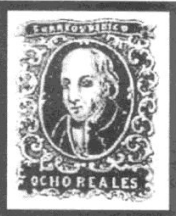
This counterfeit is illustrated in Figure 3. It is Earée's First Forgery and was unknown to Serrane. Only the 2-reales in grayish green is known. It is lithographed on coarse white wove paper of medium thickness (about 0.08 mm). This is the scarcest of the counterfeits listed by Earée. The author has only encountered two examples of this counterfeit during the more than 20 years of looking for this type of material. These counterfeits have no district overprints and both of the known examples are cancelled. The counterfeit in Figure 3 has a wavy black manuscript cancel and the other example has a small illegible portion of a fairly large round black cancel.
This counterfeit looks nothing at all like the genuine. Some of its features are:
- There is a thick colored line around the entire stamp.
- The background behind the upper and lower labels is solid and not formed of lines as in the genuine.
- The upper label has no forked ends or outline. In the genuine there is an outline around the upper label and the label has forked ends.
- There are no buttons or pleats in the shirtfront. In the genuine the shirtfront has two buttons and pleats.
- There is a colored rim on the outside border of the colorless rim around the central medallion. On the genuine there is no colored rim on the outside of the upper right quadrant of the colorless rim, (On well-printed genuine stamps there may be some faint lines on the outside boundary of the upper right quadrant of the colorless rim, but there is no solid rim in this region.)
Counterfeit Type III
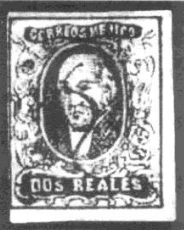
This is Earée's Second Forgery and is Serrane's Counterfeit B. This type consists of a blue ½-real stamp only. The stamps are printed by lithography on either a white hard wove paper or on a grayish hard wove paper. Both papers are of medium thickness (about 0.08 mm). A Type III Counterfeit is illustrated below in Figure 4.

The stamps have no district overprints and all are cancelled. The cancels are black and are printed on the stamps by lithography. It is possible to find sheets containing 45 stamps. 9 horizontal by 5 vertical. Printed on these sheets in black are a variety of fragments of circles, fragments of ovals, and fragments of straight-line dates. Some of these geometric fragments contain words or fragments of words such as "EN/18/ME," "RREOS," "REALE," and "MEJICO." Some of the dates are "1823" and "183." The effect is to place a black partial cancel on every stamp in the sheet. The cancel fragments do not always register well with stamps. The cancels do imitate, fairly well, genuine Mexico cancels of the period. Again, the bust of Hidalgo on this stamp does not at all like the bust of Hidalgo on the genuine. Some of the characteristics of this counterfeit are:
- "MEJIOS" instead of "MEJICO" in the inscription in the upper label.
- The letters of "MEDIO REAL" are about half as tall as in the genuine stamp.
- The letters of CORREOS MEJIOS" are about three-quarters as tall as "CORREOS MEJICO" in the genuine stamp.
- There is a blue rim on the outside border of the colorless rim around the central medallion. On the genuine there is no blue rim on the outside of the upper right quadrant of the colorless rim. (On well-printed genuine stamps there may be some faint lines on the outside boundary of the upper right quadrant of the colorless rim, but there is no solid rim in this region.)
The Type III counterfeits are plentiful.
Counterfeit Type IV
The Type IV counterfeits consist of three lithographed stamps, a 2-reales grayish green on off-white paper of medium thickness (0.09 mm), a 4-reales red on thick (0.14 mm) yellow wove paper, and an 8-reales grayish violet on medium (0.09 mm) off-white wove paper. The designs of these stamps are similar, but are not identical. There are small minor differences in the three stamps. They are grouped in the same counterfeit type because of their similarity in appearance and because all three have similar forged cancels. Figure 5 illustrates the three Type IV counterfeits.
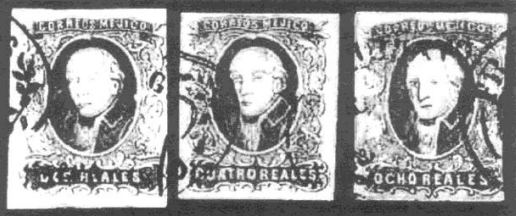
The 2-reales stamp is Earée's Fourth Forgery and Serrane's Counterfeit G. Earée was not aware of the other denominations. Serrane refers to his Counterfeit G as "a few values including the 2-reales". It can be assumed that Serrane's "few values" are those listed here as Type IV.
The counterfeits have no district overprints and all are cancelled. The stamps bear lithographed black partial cancel strikes that do not always register properly. These cancels include: Part of a straight line "GUANAJUATO"; a straight line "EROAÑ"; part of an oval cancel with "CORREOS", "MEJICO", and ornaments; part of a round double circle cancel with "FRANCO"; part of a rectangular cancel with curved ends containing a terminal "LIAN"; and a portion of a box cancel containing two illegible letters. Some of the stamps have markings that resemble Eagle consignment numbers such as "104 - 18- -", "106 18- -", "107- 18 --".
Some of the common characteristics of the stamps that are different from the genuine are:
- The letters in the inscriptions of value in the lower labels are about two thirds as tall as the letters on the genuine stamps.
- The height of the letters in the inscription "CORREOS MEJICO" in the upper label is about two-thirds the height of the letters on the genuine stamps.
- The background behind the bust is formed of horizontal lines crossed by very fine oblique lines running down from right to left. On the genuine stamps the fine oblique lines run down form left to right.
- There is a colored rim on the outside border of the around the central medallion. On the genuine there is no colored rim on the outside of the upper right quadrant of the colorless rim. (On well-printed genuine stamps there may he some faint lines on the outside boundary of the upper right quadrant of the colorless rim, but there is no solid rim in this region.)
- On the 4-reales counterfeits there are red diagonal line segments that run through the "R" of "REALES" up to a point in the right margin about one third of the way from the top of the stamp.
The type IV counterfeits are plentiful today.
Counterfeit Type V
This crude counterfeit is lithographed on wove paper. The paper exhibits a variety of colors and varies in thickness from thin (0.06 mm) to thick (0.12 mm). This is Earée's Fifth Forgery and Serrane's Counterfeit D. An example of a Type V counterfeit is illustrated in Figure 6.
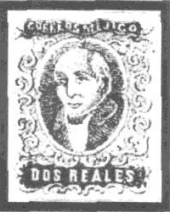
This set contains counterfeits of the five 1856 denominations, the seven 1861 denominations, and the 1867 2-reales green on thin gray blue paper. There are also two color varieties: a ½-real grayish blue on gray and a 4-reales deep green on light yellow. The specific 1856 counterfeits are ½-real blue on white, 1-real light brown on white. 2-reales green and shades of green on white, 4-reales violet brown on pink and reddish brown on white, and 8-reales dark brown on white. The 1861 counterfeits are ½-real black on reddish brown, 1-real black on green. 2-reales black on pink, 4-reales black on grayish yellow, 4-reales brownish red on deep yellow, 8-reales black on reddish brown, and 8-reales dark green on light brown. The 1867 counterfeit is a 2-reales deep green on bluish gray paper.
These counterfeits do not have district overprints. About twenty percent of them do not have cancels. The rest are cancelled with a variety of black mute cancels that include portions of grids, portions of concentric circles, portion of ovals made up of small diamonds, and portions of round cancels with illegible words.
There is a weak frame line around each stamp.
The principal differences between these counterfeits and genuine stamps, aside from the very poor bust of Hidalgo, are:
- Hidalgo's lips are too prominent.
- All the letters of the inscription "CORREOS MEJICO" in the upper label are very defective. The most obvious are the second "O" of "CORREOS" which is about half the size of the other letter in the label, and and the "C" of "MEJICO" which looks more like a "G" than a "C".
- The background of the upper label is solid and not made up of lines.
- There is a colored rim on the outside border of the colorless rim around the central medallion. On the genuine there is no colored rim on the outside of the upper right quadrant of the colorless rim. (On well-printed genuine stamps there may be some faint lines on the outside boundary of the upper right quadrant of the colorless rim, but there is no solid rim in this region.
Type V counterfeits are plentiful today.
Counterfeit Type VI
This type consists of a 4-reales brown stamp. It was printed by lithography on white wove paper of medium thickness (about 0.10 mm). This is Earée's Sixth Counterfeit and Serrane's Counterfeit C. Because both Earée and Serrane list this as a counterfeit of Mexico's 1856 issue, it is included in this paper. Actually, this is a counterfeit of the 4-reales brown of Mexico's 1864 issue (Scott No. 16). It was made by the makers of the Type V counterfeits who used the bust of Hidalgo, the central oval, and the scrollwork of the Type V counterfeit. The Type V top label was altered so that "CORREOS MEJICO" appears as colored letters on a white background, and the shape of the lower label was altered to resemble the shape of the lower label of the 1864 issue. Figure 7 shows a genuine 1864 4-reales stamp and the Type VI counterfeit.
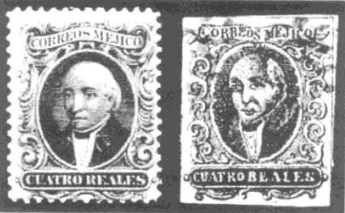
Many, of the counterfeits have weak frame lines on one or more sides. It is probable that there was a frame line around each stamp in the sheet. There is no district overprint on these counterfeits. All of the examples known to the author are cancelled with a mute black cancel made up of small diamonds. Some of the principal features that distinguish this counterfeit from stamps of the 1856 and 1861 issue are:
- The inscription in the upper label is brown on a white background. This inscription on the genuine is colorless on colored background.
- Hidalgo's lips are too prominent.
- The background of the lower label is solid. The background of the genuine lower label is made up of crossed lines.
- There is a colored rim on the outside border of the colorless rim around the central medallion. On the genuine there is no colored rim on the outside of the upper right quadrant of the colorless rim. (On well-printed genuine stamps there may he some faint lines on the outside boundary of the upper right quadrant of the colorless rim, but there is no solid rim in this region.)
Feature 2 also serves to distinguish this counterfeit from the genuine 1864 stamp. Other features that distinguish this counterfeit from the genuine 1864 stamp are:
- The letters "CORREOS MEJICO" in the upper label and "CUATRO REALES" in the lower label are very defective.
- There is not a colored border on the lower side of the upper label.
- There is no scrollwork above the upper tablet as there is on the genuine stamp.
- The letters of "CUATRO REALES" in the lower label are much thinner on the counterfeit than on the genuine 1864 stamp.
- The scrollwork on the side of the counterfeit is totally different from the scrollwork on the genuine.
- The counterfeit is imperforate. The genuine stamp is Perf. 12.
Type VI counterfeits are moderately plentiful today.
Counterfeit Type VII
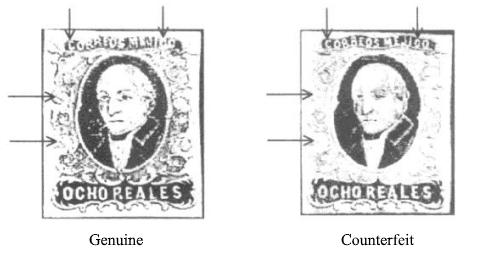
The Type VII counterfeits consist of 8-reales stamps printed with an engraved plate. The 1856 8-reales stamp and both 1861 8-reales stamps have been counterfeited. This is Earée's Seventh Forgery, and is Serrane's Counterfeit H. All three counterfeits of this type are deceptive, but the shades of the 1856 violet stamp and the 1861 green stamp betray them as counterfeits. The 8-reales black on colored paper is a dangerous forgery of Scott No. 11. Figure 8 shows a genuine 8-reales stamp and a Type VII counterfeit, with arrows pointing out some of the principal differences.
Type VII counterfeits of the 1856 8-reales stamps are dull violet on white and reddish lilac on white. The white paper is wove and of medium thickness (about 0.08 mm). Both colors are different from the genuine shades of this stamp, and this is the first clue to the true nature of the 1856 Type VII counterfeits. The dull violet on white in the author's collection exhibits a very weak impression. This impression is much weaker than any impression encountered on the genuine.
Type VII counterfeits of the 1861 stamps include an 8-reales black on light brown paper and on brownish orange paper, and an 8-reales grayish green on light brown paper and on grayish yellow paper. The papers are wove and are fairly thin (about 0.06 mm). The 8-reales black stamps have strong black impressions and can be easily taken as genuine. The 8-reales green stamps have weak impressions and the shade of green is different from any of the greens of the genuine.
Some of the Type VII counterfeits have gum. It is probable that the counterfeits were gummed before they were "issued".
There is an 8-reales black on light brown that exhibits a double impression over the right half of the stamp.
Most of these counterfeits do not have a district overprint or a cancel. However, in the collection of the author are one of each of the three counterfeits with a similar black "GUADALAJARA" overprint. The overprints have no periods and their dimensions are 22 x 2.5 mm. This is unlike any of the genuine Guadalajara overprints and provides another clue to the true nature of these particular counterfeits. In this set the 8-reales black on light brown is cancelled with a vertical blue manuscript line, and the 8-reales grayish green on light brown is cancelled with a blurred corner strike of an illegible round black cancel.
Also seen on the counterfeits are a blurred overprint that resembles a Gothic Mexico and an illegible round cancel. A couple of counterfeits are known with illegible black elliptical cancels. There are probably other examples of overprints and cancels that are unknown to the author. Nevertheless, the majority of the Type VII counterfeits do not have overprints and cancels.
One well-known test for unauthorized reprints of the 4-reales and 8-reales 1861 stamps is to hold the stamp up to a light and look at the paper. The paper of genuine stamps and unauthorized reprints will exhibit tiny elongated grains — vertical grains for the reprints and horizontal grains for genuine stamps and some reprints. The Type VII counterfeits on colored paper fail this test. The paper of the counterfeits does not have a granular pattern similar to the genuine stamps and reprints, instead, the paper appears to have blotches that overlie a pattern of grains that is much denser in grains than the genuine and reprint 1861 paper.
Other differences between this counterfeit and the genuine stamps are:
- The leaves on the vine ends on the left side of the stamp turn up. On the genuine these leaves turn completely to the left, See Figure 8.
- The background lines behind the bust of Hidalgo are too heavy. This makes the central part of the counterfeit stand out much more prominently than the central part of the genuine.
- The "C" of "CORREOS" and the "C' of "MEJICO" are oval. On the genuine the left part of both these C's are straight and vertical.
In an 1871 article in The Stamp-Collector's Magazine [8], Englehardt Fohl is attacked for selling 8-reales stamps of Mexico in violet, brown, and green on brown that were "some of the most dangerous forgeries ever brought on the market." It is further stated in the article that a house in Leipzig fabricated these counterfeits for Fohl. It is probable that the Type VII counterfeits are those distributed by Fohl. These engraved counterfeits are considerably less plentiful than most of the lithographed counterfeits. Still, the 8-reales black on colored paper is fairly common. The 8-reales green on colored paper is somewhat less common. The counterfeit of the 1856 8-reales stamp is scarce, and the author has only encountered five examples of it.
Counterfeit Type VIII
Counterfeit Type VIII is lithographed on paper of medium thickness (about 0.09 mm). It is rather well done, especially when compared to the first six types discussed in this paper. This counterfeit was unknown to Earée and it is Serrane's Counterfeit E. This counterfeit was distributed by François Fournier [3], Figure 9 shows a 4-reales example of a genuine stamp and the Type VIII counterfeit.
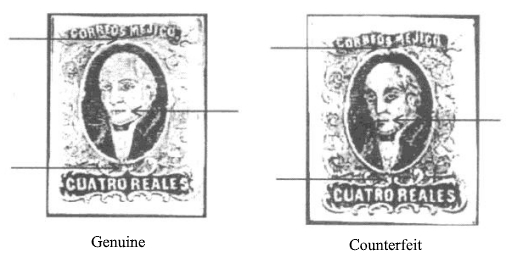
All five denominations of the 1856 stamps have been counterfeited in this type. However, this type contains only one denomination from the 1861 set, the 4-reales red on yellow. A ½-real medium gray on gray counterfeit of the 1867 ½-real black on thin gray blue paper also exists.
The Type VIII counterfeits were issued in sheets of 25, but the printed sheet may have been larger. Apparently, there was at one time a frame line around each stamp. The horizontal components on the frame lines remain on the sheets, but most of each vertical frame line has been erased.
The 1856 counterfeits were printed on white wove paper. A light colored solid background was first printed on the paper, and then the stamps were printed over the solid background. For this reason the counterfeits appear to be printed on a colored paper when viewed from the front, but the paper appears to be white when viewed from the back. Some ½-real counterfeits are known printed directly on the white paper. The colors of the 1856 stamps, when viewed from the front, are ½-real deep blue on light bluish gray and blue on white, 1-real orange on light brownish orange, 2-reales grayish green on light grayish yellow, 4-reales brownish red on light orange gray, and 8-reales grayish violet on brownish gray.
The only 1861 counterfeit is the 4-reales red on yellow. This stamp is printed on yellow paper and no background has been added. The 1867 counterfeit is the ½-real medium gray on light gray paper with no background added.
There are two groups of these counterfeits in so far as the district overprints and cancels are concerned. Stamps in the first group have no district overprint and the majority of them are uncancelled. Those that are cancelled are cancelled with an oval grid of black lines, a large double circle round black cancel with an illegible inscription, or with a cancel made up of small black diamonds. Some of the stamps in this group have the overprint FAUX" in small black letters. This "FAUX" overprint was applied by L'UNION PHILATELIQUE DE GENEVE to some of Fournier's stock acquired by them after his death. There is one known exception to the no-overprint rule in the author's collection: There is a 4-reales red 1856 counterfeit with a black manuscript "MEXICO" in block letters. Fournier offered the 1856 stamps in sets cancelled or uncancelled. The cancels on these stamps were probably applied by Fournier to his stock of uncancelled stamps. All of the 1856 counterfeits and the single 1861 counterfeit are included in this group. Stamps in the second group of counterfeits have a forged cancel that is different from the cancels in the first group and most have a forged district overprint. Stamps in this group include all of the 1856 counterfeits and the single 1861 counterfeit.
The overprints and cancels are black unless noted otherwise. The overprints and cancels (naturally only part of the cancel appears on a stamp) noted are:
- Saltillo district overprint cancelled with an illegible red elliptic cancel.
- Saltillo district overprint and the overprint "40 73" along the right side of the stamp in a format similar to the overprints on 1868 issue. These are cancelled with a double overlapping ellipse cancel with "FRANCO" in the top part and an illegible town name in the lower part.
- Saltillo district overprint and cancelled with an illegible CDS type cancel. The size of these Saltillo overprints is about 14 x 2.5 mm. They are much larger than the genuine Saltillo overprints.
- Oaxaca ("Oajaca") district overprint cancelled with an Oaxaca box cancel with "OAXACA" and "AUGUSTO" in the box. The size of the "Oajaca" overprints is about 14 x 2 mm including two stops. This is about 1 mm shorter than the genuine overprint, but it is a fairly good counterfeit of the overprint.
- Veracruz district overprint cancelled with a round CDS type cancel.
- Veracruz district overprint cancelled with a red round CDS type cancel.
- Veracruz district overprint with a "50 73" overprint along the right edge of the stamp in the 1868-overprint style and cancelled with a two-line "FRANCO/ANTEPE..." cancel.
- Veracruz district overprint and the overprint "40 73" in the 1868 style along the right edge of the stamp. The cancel is a grid of lines. The example in the collection of the author also has part of a "FAUX" overprint. The size of the Veracruz overprints is about 12.5 x 2 mm. This is somewhat shorter than the genuine.
- Mexico district overprint and cancelled with a "MEXICO/NOVIEMBRE" two-line cancel.
- Mexico district overprint cancelled with a round Mexico CDS Cancel. Several dates have been noted in the center of the cancel. The size of the Mexico district overprints is about 14 x 2 mm and it is a good imitation of one of the genuine overprints.
- Ures district overprint with the overprint "50 73" along the right edge of the stamp in the 1868-overprint style. These are cancelled with a fancy figure 8 cancel similar to the cancel of that shape from Guadalajara and Ciudad Guzman. These cancels are Schatzkés [9] Nos. 300 and 343.
- Ures district overprint and the "50 73" overprint along the right side of the stamp in the 1868 style. These are cancelled with a Mexico CDS type cancel.
- Ures district overprint cancelled with a straight line "FRANCO" cancel. The size of the Ures overprints is about 7 x 2 mm. There are no genuine Ures district overprints on the 1856 and 1861 stamps.
- Jalapa district overprint cancelled with a straight line "JALAPA" cancel. The size of the Jalapa overprint is about 14 x 2 mm including two stops. The overprint is a good imitation of the genuine overprint.
- Puebla district overprint cancelled with "PUEBLA/OCTUBRE" in two straight lines. The size of the Puebla overprint is about 14 x 2 mm including two stops. It is a good imitation of the genuine.
- Without overprint and cancelled with a manuscript "N".
- Without overprint and cancelled with faint wavy curved lines.
- Without overprint and cancelled with the "FRANCO/ANTEPE..." two-line cancel.
- Without overprint and cancelled with a Mexico CDS cancel.
The only two 1867 medium gray on gray stamps known to the author have no district overprint and are cancelled with a portion of a faint round cancel.
These Type VIII counterfeits are plentiful. Sheets of 25 and large blocks are not hard to come by. In Fournier's 1914 Price List [3] he offers a set of five of the 1856 issue and a set of five of the 1861 issue (the real 1861 issue consisted of seven stamps). The five 1856 stamps are described in this paper. It is curious that only one denomination of the 1861 set is known to exist today. A possible explanation can be constructed from the Lowell Ragatz essay that accompanies the 1914 price list [3]. Soon after the publication of the 1914 price list, Fournier was forced out of business by the difficulties of shipping his material across international borders caused by the advent of World War I in August 1914. Not long after this Fournier died. Later all of Fournier's equipment and stock was purchased by a leading Swiss philatelic society in order to prevent his facsimiles from falling into the hand of unscrupulous traders. However, much of his stock had been damaged by storage in damp quarters. We can assume that the missing denominations of the 1861 issue were lost in the damp quarters. Surely Fournier must have sold a few of the 1861 sets before his demise. If so, the missing 1861 counterfeits, if they still exist, are rare.
This is a rather good counterfeit. The scrollwork and upper and lower tablets are very good copies of the genuine. The primary clues for detecting it are the flat appearance of the lithographed counterfeits and the appearance of Hidalgo, which is different from the genuine. Some differences between the counterfeit and the genuine are:
- The outer rim around the central medallion touches the upper table just below and just to the right of the "S"of "CORREOS". In the genuine there is a small space between the rim and the upper tablet.
- There are some differences in the scrollwork directly below the central medallion. See Figure 9.
- The width of Hidalgo's mouth is about half the width of the genuine.
Counterfeit Type IX
This counterfeit type was unknown to Earée and it is Serrane's Counterfeit F. It is lithographed on a variety of wove papers. Figure 10 shows the 2-reales version of this counterfeit type along side a genuine 2-reales stamp. Neither the 1856 nor the 1861 set are complete in this type. The 1856 set contains the ½-real through the 4-reales denomination, but there is no 8-reales denomination. The 1861 set contains five denominations, but it does not contain the ½-real denomination, nor does it contain the 4-reales black on yellow. The printing stones for these missing denominations obviously existed and we can only wonder why complete sets of both issues were not printed.
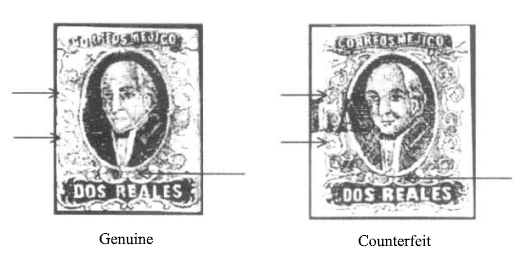
The 1856 Type IX counterfeits were printed on an off-white (light grayish orange) paper of medium thickness (about 0.09 mm). The colors of the stamps are ½-real blue, 1-real yellow, 2-reales grayish green, and 4-reales red. The 1861 counterfeits are printed on colored paper that approximates the color of the paper of the genuine stamps. Most of the 1861 counterfeit paper is of medium thickness (about 0.07 to 0.09mm). The grayish green paper of the 1-real stamp is somewhat thicker than medium (about 0.10 to 0.11 mm). The 1861 counterfeits are 1-real black on grayish green paper, 2-reales black on pink and on off-white (light grayish yellow), 4-reales orange red on yellow, 8-reales black on brown, and 8-reales grayish green on brown. In addition there are two color varieties: These is a 1-real black on greenish blue, and a 2-reales greenish blue on gray. The latter may be an imitation of the 1867 2-reales green on thin gray blue paper.
The Type IX counterfeits were issued in sheets of 25 (5 x 5), but the printed sheet may have been larger. There is an array of fake black cancels printed on each sheet. There are ten different configurations of cancels. Each is comprised of several strikes of a double circle cancel with a curved "FRANCO" and a straight line "MEXICO" in the circle, a grid of crossed lines in a circle, and either a two-line "PUEBLA/FRANCO", or a straight line 'PUEBLA". Sheets with the "PUEBLA/FRANCO" do not have the straight line "PUEBLA". Most of the round Franco Mexico cancels are oriented in the same direction as the stamp (there are a couple of exceptions that are oriented about 45 degrees with respect to the stamp). Some of the Puebla cancels are vertical and some are horizontal. Single stamps contain only a portion of one of these four cancels.
A few Type IX counterfeits exist without cancels. One of the ten configurations of cancels does not cover position 23 with a portion of a cancel. This is the source for some of the uncancelled counterfeits. It is also possible that some of the sheets of counterfeits received no cancels. Whatever the source, uncancelled Type IX counterfeits are scarce.
The Type IX counterfeits do not have a district overprint.
These counterfeits have the usual flat appearance of lithographed stamps, and the bust of Hidalgo only barely resembles the Hidalgo of the genuine. Some of the other differences are:
- The background of the upper label is solid and not comprised of lines.
- There are differences in the scrollwork just below the center of the central medallion. See Figure 10.
- The leaves on the vine ends on the left side of the stamp turn up. On the genuine these leaves turn completely to the left, See Figure 10.
- "C" of "CORREOS" is very open in the counterfeit.
- The letters "J". "I", and "C" of "MEJICO are very thin in the counterfeit.
- On most denominations the letters of the lower value tablet are thicker than the corresponding letters on the genuine. The 1-real counterfeit and the 4-reales counterfeit are exceptions.
- There are 9 lines and a small blob in Hidalgo's right lapel (left side of stamp) and 16 lines in the same lapel of the genuine. There are 9 lines in Hidalgo's left lapel and 14 lines in the genuine.
- There is a colored rim on the outside border of the colorless rim around the central medallion. On the genuine there is no colored rim on the outside of the upper right quadrant of the colorless rim. (On well-printed genuine stamps there may be some faint lines on the outside boundary of the upper right quadrant of the colorless rim, but there is no solid rim in this region.)
Type IX counterfeits are plentiful.
Counterfeit Type X
These are crude counterfeits lithographed on wove paper ranging in thickness from thin (0.06 mm to thick (0.15 mm). These counterfeits were unknown to both Earée and to Serrane. The counterfeits are crude and of a quality that suggests they were printed in the l9th century, and they are moderately plentiful today. It is curious that they neither Earée nor Serrane were aware of them. Perhaps, in spite of their appearance, they are of recent origin. A Type X counterfeit is illustrated in Figure 11.
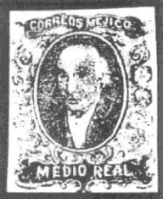
These counterfeits consist of a complete set of five of the 1856 issue and all but one denomination of the 1861 issue. The 1861 set does not contain a counterfeit of the 4-reales black on yellow. Some of these counterfeits are printed on white paper, some on white paper with a background printed on the stamp side, and some on colored paper. The paper of the stamps that are printed on the surface colored paper will be appear to be colored when viewed from the stamp side, but will appear to he white when viewed from the back.
The 1856 set consists of a ½-real blue on light bluish gray surface colored paper, 1-real grayish orange on light orange gray surface colored paper, 2-reales grayish green on white paper, 4-reales red on white paper, 8-reales ruby red (shades) on light grayish red surface colored paper. There is one color variety: a 2-reales light blue on light grayish orange paper. Most of the 1856 paper is in the range of medium (0.08 mm) to medium thick (0.11 mm); however, some of the 1-real paper is thin (0.06 mm).
The 1861 set consists of a ½-real black on grayish orange paper, 1-real black on grayish green surface colored paper, 2-reales black on pink surface colored paper, 4-reales red on yellow paper, 8-reales black on brownish orange surface colored paper, and 8-reales deep green on light brown surface colored paper. In addition to the 1861 set there are three color varieties: a ½-real black on pink surface colored paper, a 2-reales black on a light grayish orange paper, and an 8-reales dark green on light brown surface colored paper. Most of the 1861 paper is in the range of medium (0.07 mm) to medium thick (0.11 mm); however, some of the ½-real paper is thick (0.15 mm).
These counterfeits do not have district overprints. About five percent of them are without cancels. Some of the fake cancels on these stamps are a cancel made up of small black diamonds, portions of an illegible black CDS type cancel, a black circular cancel with a number (408 and 853) and bars, and a grid of black lines. These cancels are printed on the stamps by lithography.
There are many faint frame lines visible on the counterfeits, and it is probable that there was a faint frame line around each stamp in the sheet.
These counterfeits are very crude lithographs. The bust of Hidalgo looks nothing like the bust of the genuine and it is unlikely to deceive anyone. Some of the differences between it and the genuine are:
- Hidalgo's head is only about two thirds as wide as the head on the genuine.
- The backgrounds of the upper tablet and lower tablet are solid and are not made up of lines as on the genuine. (There are some little colorless spots in these tablets, but there are no lines.)
- The rim of the oval around the central medallion touches the upper tablet, On the genuine there is a small space between the rim and the upper tablet.
- The colorless rim around the central medallion is clear. The colorless rim of the genuine has little structures at 3, 6, 9, and 12 o'clock.
- There is one button on Hidalgo's shirtfront, not two buttons as on the genuine.
- There is a colored rim on the outside border of the colorless rim around the central medallion. On the genuine there is no colored rim on the outside of the upper right quadrant of the colorless rim. (On well-printed genuine stamps there may be some faint lines on the outside boundary of the upper right quadrant of the colorless rim, but there is no solid rim in this region.)
The Type X counterfeits are moderately plentiful today.
Counterfeit Type XI
This type consists of only the 2-reales grayish green and shades of grayish green printed by lithography on a white card. The thickness of the cards used range from 0.2 to 0.3 mm. Printing can be found on the back of most of these counterfeits. On some of these counterfeits the card has been shaved so that it appears that the stamp is printed on paper. This counterfeit is illustrated in Figure 12.
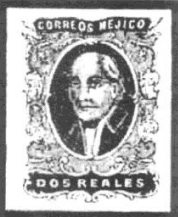
This counterfeit was unknown to both Earée and Serrane.
The counterfeit exists without cancel and with a variety of black cancels. Some of the cancels include a black grid of hollow bars, a diagonal crossed mesh in a circle, a square cancel with a star in the corner, and a grid of dots. The cancels are also lithographed.
These counterfeits were cut from a Victorian Trade Card. Victorian Trade Cards are cards with a colorful picture on one side and advertising on the other side. The cards are typically about 3 x 4 inches in size. They reached their height of popularity during the 1875-1900 period. The card that contained the picture of this 1856 stamp also contained a picture of a Mexican Eagle stamp, a Maximilian stamp, and an 1874 stamp along with a picture of a Mexican mail carrier of about 1800. This particular trade card was issued by Chromos Pancartes Reclames of Belgium in about 1900, and it is known with a number of different advertisements on the back. Some of the advertisements are Clark and Co. Anchor Cottons, The Accident Insurance Co. of New York, Shepard, Norwell and Co. Importers, Boston. There are probably many other advertisements on these cards. In the collection of the author each card with a different advertisement has a different set of cancels on the stamps. Perhaps the cancels were changed so that each advertiser could have card that was different from the card of any other advertiser.
This counterfeit is rather poor and the bust of Hidalgo looks nothing like the bust on the genuine stamp. The stamp is on card or scraped card rather than paper and this serves to condemn it. Some specific differences between the counterfeit and the genuine are:
- The upper and lower tablets are solid and not made up of lines as on the genuine.
- The letters of "DOS REALES" are about half as tall as the corresponding letters on the genuine.
- There is a single small structure oriented to the right in the lowest part of the rim surrounding the central medallion. On the genuine there are two small structures oriented to the left in this position
- The lines forming the right lapel of Hidalgo's coat (left side of stamp) run down from left to right. On the genuine these lines run down from right to left.
- There are no buttons on Hidalgo's shirtfront. On the genuine there are two buttons.
- There is a colored rim on the outside border of the colorless rim around the central medallion. On the genuine there is no colored rim on the outside of the upper right quadrant of the colorless rim. (On well-printed genuine stamps there may be some faint lines on the outside boundary of the upper right quadrant of the colorless rim, but there is no solid rim in this region.)
Counterfeit Type XI is moderately plentiful.
Counterfeit Type XII
This counterfeit type consists of a ½-real deep blue stamp on white wove gummed paper. It was cut from a Mexican stamp that was issued to honor the International Philatelic Exhibition in Mexico City on August 16, 1956 (Scott No. 897). It may seem to be somewhat extreme to call this a counterfeit. In the view of the author the ½-real stamp when cut from the master stamp is a rather good imitation of the original and could fool the uninitiated. This counterfeit was obviously unknown to both Earée and Serrane. It is illustrated in Figure 13.
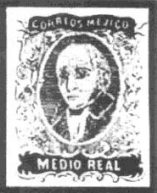
The examples seen by the author have neither overprint nor cancel. They have full gum. The paper has a vertical MEX-MEX and Eagle in Circle watermark. The principal feature of this counterfeit is that it is noticeably smaller than the genuine. It is about ninety percent the size of the genuine. The smaller size is the principal distinguishing feature of this counterfeit. Some of the other differences between it and the genuine stamp are:
- Letters of "CORREOS MEJICO" are much too thin.
- There is no outer border around the upper tablet. There is an outer border around the upper tablet of the genuine.
- There are no round buttons on Hidalgo's shirtfront. The genuine has two round buttons.
- There is a small white region just above the point where the right lapel (left side of the stamp) touches the circular rim around the central medallion.
Counterfeit Type XIII
This is a very crude lithographed counterfeit on rough light grayish orange (light tan) wove paper. The author has seen only two examples of this counterfeit. Both are the ½-real denomination. One of the counterfeits is a grayish magenta and the other is a reddish brown. Both stamps are on smoothed out wrinkled paper and both have a black cancel that consists of a "39" in four broken concentric circles. There are no district overprints on the stamps. This counterfeit was unknown to both Earée and Serrane. This counterfeit is illustrated in Figure 14.
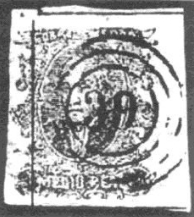
This counterfeit is very crude. The bust of Hidalgo looks nothing at all like the bust on the genuine. Some of the characteristics of this counterfeit are:
- The lettering of "CORREOS MEJICO" and "MEDIO REAL" is very crude.
- The letters of "CORREOS MEJICO" are about half as tall as the corresponding, letters on the genuine.
- There are no round buttons on Hidalgo's shirt. There are two round buttons on the shirt of the genuine stamp.
- There are only horizontal lines in the background of the central medallion. In the genuine there are horizontal lines crossed by tiny diagonal lines.
- There is a colored rim on the outside border of the colorless rim around the central medallion. On the genuine there is no colored rim on the outside of the upper right quadrant of the colorless rim. (On well-printed genuine stamps there may be some faint lines on the outside boundary of the upper right quadrant of the colorless rim, but there is no solid rim in this region.)
Counterfeit Type XIV
The author has been able to obtain only one example of this counterfeit. Unfortunately it has a blue blob cancel that obscures most of Hidalgo's face. The stamp is a 4-reales light rose lithographed on light gray wove paper. The paper is medium thickness (about 0.1 mm). The stamp does not have a district overprint. This counterfeit was unknown to both Earée and Serrane. It is illustrated in Figure 15.
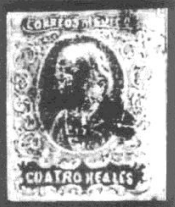
Even without a good view of Hidalgo's face, it is easy to conclude that this counterfeit bears little resemblance to the genuine stamp. Some specific differences are:
- Hidalgo's shirtfront curves downward to the right. On the genuine the shirtfront comes straight down.
- The background of the upper and lower tables is solid. On the genuine the background is comprised of lines.
- The lettering of "CORREOS MEJICO", and especially of the "CUATRO REALES", is very crude.
- The lettering of "CUATRO REALES" is noticeably smaller than on the genuine. The letters are seventy percent as tall as the genuine and the inscription is about eighty percent of the length of the genuine.
- The top of "R" of "REALES" is open.
- There is a colored rim on the outside border of the colorless rim around the central medallion. On the genuine there is no colored rim on the outside of the upper right quadrant of the colorless rim. (On well-printed genuine stamps there may be some faint lines on the outside boundary of the upper right quadrant of the colorless rim, but there is no solid rim in this region.)
The differences listed previously are based on the study on a single copy of the counterfeit and are probably not as reliable as the differences given from some of the previous counterfeits based on the study of several specimens.
Counterfeit Type XV
This author has been able to obtain only one copy of this counterfeit. It is a ½-real deep blue, typographed on very thin (0.03-mm) white wove gummed paper. The stamp does not have a district overprint, nor does it have a cancel. It does have a typographed red overprint that reads "VILLA/SONORA", and the stamp thus exhibits a curious mixture of two periods in Mexico's history. This stamp was unknown to both Earée and Serrane. The stamp is illustrated in Figure 16.
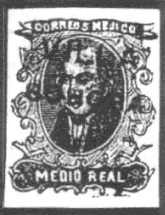
Other denominations of this counterfeit may exist. It is obvious that the "MEDIO REAL" has been inserted into the design.
The counterfeit is a very poor imitation of the genuine. The thin white paper and the strange overprint serve to condemn the copy studied by the author. Of course, copies may exist printed on thicker paper and/or without the overprint. Some of the specific differences between it and the genuine are:
- There is structure extending to the right of Hidalgo right eye (left side of stamp). This appears to be an ear, but it could be a lock of hair. The genuine has no such extension.
- The background of the central medallion consists of horizontal line only. The background of the genuine consists of horizontal lines crossed by fine diagonal lines.
- There is a strong colored ring around the colorless rim that surrounds the central medallion. On the genuine there is a thin ring around part or the colorless rim. The ring on the genuine does not cover the upper right quadrant of the colorless rim. (On well-printed genuine stamps there may be some faint lines on the outside boundary of the upper right quadrant of the colorless rim, but there is no solid rim in this region.)
- There are diagonal lines behind the scrollwork. The separation of these diagonal lines from each other is about as twice as great as the separation of the corresponding diagonal lines on the genuine.
Counterfeit Type XVI
This counterfeit type consists of a ½-real dark gray on thin gray paper. It is Jean de Sperati's [10] counterfeit of the 1867 ½-real stamp printed on thin gray blue paper. This is an excellent and dangerous counterfeit. The counterfeit was made with a contact photolithographic process. The counterfeit's design is a photographic copy of a genuine stamp, and is therefore accurate in dimensions and most details. One of these counterfeits and a genuine stamp are illustrated in Figure 17.
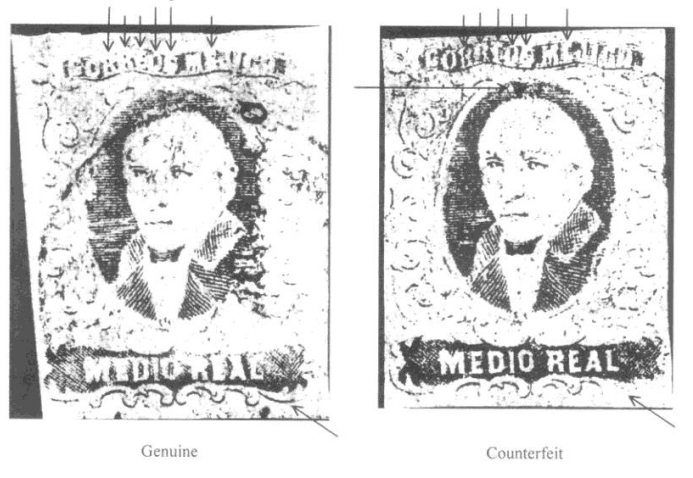
Sperati also made "die proofs" of this stamp. These are not actual die proof because did not use a die to print the stamps. The so-called die proofs consist of the stamp printed in the middle of a piece of paper that is considerably larger than the stamp design. They look like die proofs and are generally referred to as die proofs. Sperati frequently signed these. The "die proof" in the author's collection is printed on a good wove paper of medium thickness (0.09 mm). It is about 4 x 6 cm in size.
In 1953 The British Philatelic Association (BPA) purchased all of Sperati's stock, files, reference collections, equipment, and ink formulas copyrights. Based on study of this material and older reference material, the BPA published The Work of Jean de Sperati [10] in 1956. This book has a detailed description of all (or what is believed to be all) of Sperati's products. The Mexico ½-real 1867 is, of course, included in the book. The BPA states that this counterfeit was probably made prior to 1930. They further state that "Sperati is known to have made 'die' proofs in colour as well as unused and used reproductions."
The author has had the good fortune to be able to examine three examples of this counterfeit and one die proof. In addition there is a good illustration of the stamp in BPA book. The observations about this counterfeit are based on a study of these examples and illustrations. There may be some examples of this counterfeit that do not conform to the following observations about paper, watermark, and overprint. However every example of the counterfeit should have a design exactly like the illustration because Sperati only produced one cliché for the manufacture of this stamp.
The counterfeit being printed by lithography has a flat appearance; however, the genuine stamps were printed with worn plates and they also have a flat appearance, very much like lithographic printed stamps. The genuine stamps are printed on a thin (0.06 - 0.07) bluish gray paper that is watermarked R.P.S in the sheet. About one third of the stamps show the watermark. The counterfeits are printed on a thin (about 0.06 mm) gray paper without watermark. This paper seems to be slightly thinner than the genuine paper. One of Sperati's specialties was the removal of the design from a cheap watermarked stamp and then using the resulting blank paper as a base for a counterfeit of a more expensive variety having that watermark. Thus the counterfeit would have the correct watermark. He seems to have not done this with Counterfeit Type XVI.
Most genuine specimens of this stamp have a Gothic Mexico overprint. The counterfeits do not have an overprint or a cancel. Sperati tended to avoid overprints on his products unless they were absolutely necessary, so it is not surprising that he did not provide one for this counterfeit.
Each of the three counterfeits observed by the author has some light brown staining. One is almost entirely covered with the stain, about half of another is covered by the stain, and the third has two stain spots that are about 3 mm in diameter. The origin of the stain and its purpose if any are unknown.
The design of this counterfeit is a photographic copy of a genuine stamp; however, the copy is not perfect and there are some differences in the design of the counterfeit and the genuine stamps:
- The "RREOS" in the upper tablet of the counterfeit is very defective. The two "R"s, and the first "R" in particular, are wrinkled. The middle horizontal bar of the "E" is either missing or has been twisted to the vertical. The "O" appears to have an underline. The "S" is so distorted that it is unrecognizable.
- The middle horizontal bar of the "E" of "MEJICO" in the upper tablet is missing.
- The ornaments under the "L" of "REAL" and to the right of the "L" are extremely faint.
- There are some upward curving lines just above the very top of Hidalgo's head. The genuine stamps do not have these lines.
The die proofs exhibit the same differences as the stamps.
Although this is a dangerous counterfeit, the principal problem is not a financial one. Copies of the counterfeit sell in the $100-150 range. This is approximately the same cost as a genuine Scott No. 42a. The principal problem is recognizing the counterfeit.
Acknowledgements
The author is grateful to Tony Benz for making available photocopies of a Mexico reference collection formed by a British collector and for photocopies of James Beal's comments on this reference collection. He is grateful to Vern Turnburke for loaning several stamps from his collection for study. He also appreciates Ed Leissner's gift of the counterfeit listed as Type XV. Finally, the author is indebted to Mark Johnston for assistance in the preparation of this paper.
References
- Moens, J. B., De la Falsification des Timbres-Poste ou Nomenclature Générale de Toutes les Imitations et Falsifications ainsi que des Divers Timbres D'essais de Tous Pays, Brussels, 1862. An English translation of this work also appeared in 1862. It is E. Doble, On The Falsification of Postage Stamps, William Tregaskis, Falmouth, Great Britain, 1862. A reprint of the English translation is contained in The Early Philatelic Forgeries of All Countries, Edited by Lowell Ragatz, Educational Research Bureau, Washington, D. C., 1953.
- Dalston, Thomas, How to Detect Forged Stamps, R. Chambers, Gateshead, 1865. A reprint is contained in The Early Philatelic Forgeries of All Countries, Edited Lowell Ragatz, Educational Research Bureau, Washington, D.C., 1953.
- Ragatz, Lowell, Editor. The Fournier Album of Philatelic Forgeries, Janet van den Berg, Worthington. Ohio, 1970.
- Earée, Robert Brisco, Album Weeds; Or How to Detect Forged Stamps, Stanley Gibbon and Co, London, 3rd Edition, 1906-07. Reprinted by the Manuka-Ainslie Press, Acton, Canberra. Australian Capital Territory, date of reprint unknown.
- Earée, Robert Brisco, Album Weeds; Or How to Detect Forged Stamps, Stanley Gibbon and Co. London, 2nd Edition, 1892.
- Serrane, Fernand, Volume II - Vade-Mecum du Spécialiste-Expert en Timbres-Poste hors d'Europe, J. Castanet, Bergerac, 1929. An English translation of the Mexico section of this book appears in the January 1995 edition of the American Philatelist, American Philatelic Society, State College, PA. An English translation of the entire two-volume Vade-Mecum book, entitled The Serrane Guide, has been published by the American Philatelic Society.
- Kornerup A., and J. H. Wanscher, Methuen Handbook of Colour, Third Edition, Eyre Methuen, London, 1978.
- The Stamp-Collector's Magazine, 9, page 174, 1871.
- Schatzkés, Joseph Revised by Karl H. Schimmer, The Cancellations of Mexico 1856-1874, W. E. Shelton, San Antonio, Texas 1983.
- The Work of Jean De Sperati, Reprint Edition, James Bendon Ltd., Limassol, Cyprus. 1997. This book was originally prepared by the British Philatelic Association in 1956 and contains a detailed description of Sperati's products.

 Facebook